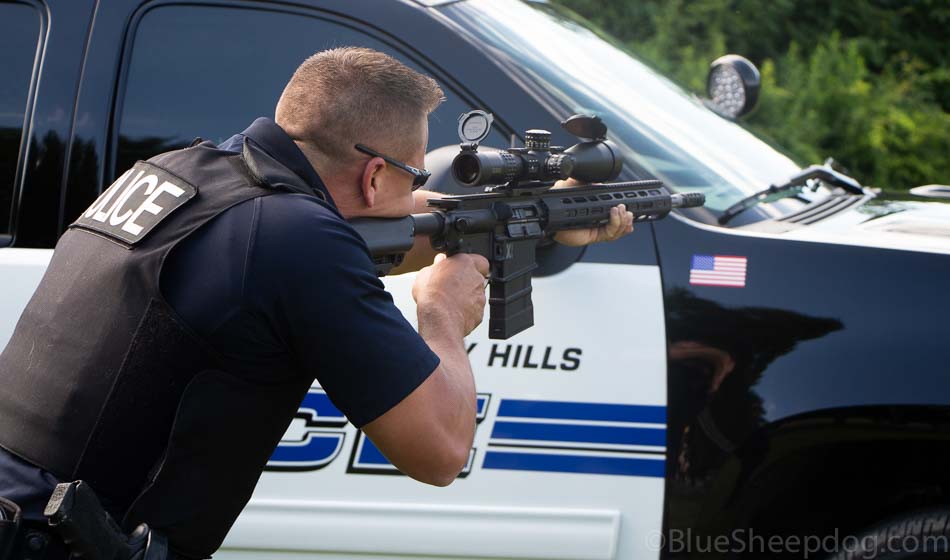
Ed. note: Aaron looks at .308 sniper ammo in this head-to-head ammunition comparison.
If you are a part of the law enforcement sniper community then many discussions on sniper rifle ammunition selection will eventually focus on the .308 caliber, 168-grain Sierra MatchKing boat tail hollow point (BTHP) cartridge.
As recently as the 2007 American Sniper Association Annual Report, the .308 caliber, 168-grain MatchKing BTHP was cited as being the “preferred ammunition” for police snipers “based primarily on its accuracy and consistency”. (Scroll down for the ASA comments on this.)
But does that mean it is the best ammunition choice? And even if it once was, does it remain so?
The .308 Win 168-grain MatchKing Load
As long as there have been police snipers wielding .308 rifles, there has been debate surround which load is the best for all of the potential scenarios in which it might be deployed.
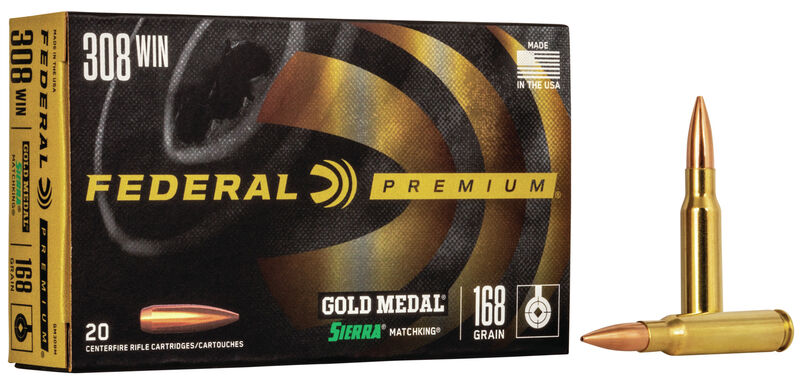
While no one argued that the 168-grain MatchKing BTHP bullet was ideal for expansion, it was tough to prove it wasn’t one of the most consistently accurate bullets available. And when precision shots are needed, that accuracy often won the argument regarding the ammunition to purchase.
For many agencies, the Federal Gold Medal cartridge was the preferred police marksman cartridge. This cartridge produces consistent match grade quality with the convenience of mass production from a factory.
The problem, however, is that the Match King bullet provided poor performance in soft tissue. While you could accurately place the bullet on target, you had little hope it would perform as well as cheap soft-point bullets that you could pick up in the hunting aisle at Walmart.
Expansion Issues
Gelatin testing and real-world experience taught me that the Sierra MatchKing 168-grain BTHP does not expand well upon impact with soft targets.
In fact, the bullet acts like an FMJ (or ball) round with a very high risk of complete blow through. Think of a needle shooting straight through gelatin and you aren’t very far off.
This situation creates an unnecessary risk to innocent persons behind the target, and therefore greatly limits their safe and appropriate use in police sniper utilizations.
Additionally, the lack of expansion reduces the likelihood of an immediately incapacitating effect on a threat. This is unacceptable for the high-risk situations police snipers will be called upon to resolve.
For these reasons, I recommend alternative .308 sniper ammunition. The ASA concurs.
ASA Comments
In the original publication of this article, I phrased information in a way that could be interpreted as an endorsement of the 168-grain MatchKing load as a recommended projectile. This included information from the American Sniper Association (ASA).
I regret that phrasing.
The president of the ASA, Derrick Bartlett, reached out and wanted to clarify information from the 2007 ASA Annual Report.
Specifically, he wanted to ensure that readers understood the ASA did not endorse sniper loads that used the 168-grain MatchKing bullet. Rather, the ASA report merely documented that most law enforcement agencies were issuing the round for duty use.
Barlett stated the ASA strongly advocates law enforcement agencies move away from cartridges that use the projectile due to its poor terminal performance.
Further, he stressed that the MatchKing bullet is phenomenally accurate but was designed for match shooting – not sniper engagements on human targets.
BlueSheepdog is very supportive of the American Sniper Association and their contribution to the law enforcement community. I completely agree with the ASA recommendation to move away from the 168-grain BTHP for police sniper use.
Alternatives
Thankfully, there are several high-expanding rounds on the market today that provide both high accuracy and the critical bullet expansion needed in a police sniper event.
In general, I recommend the use of match-grade loads that use ballistic tip bullets. These will give you excellent accuracy while vastly surpassing the Match King bullet’s ability to stop a threat.
Some excellent .308 loads to consider are:
- Federal Tactical Bonded Tip 168-grain
- Norma Tipstrike 170-grain
- Hornady TAP 168-grain ELD Match
- Winchester Ballistic SilverTip 168-grain
- Barnes VOR-TX 168-grain
There are others to consider. The above are just suggestions to get you going.
One of the keys to selecting new sniper ammunition for your team is to test a variety of loads in the rifles your department issues. We’ve all seen how one rifle will respond better to a particular load. You want to find the round that will work for your team’s rifles.
Also, it is important to ensure that the ammunition will work at reasonably foreseeable distances that your agency might need. A 1,000 yard bullet is great, but probably not a priority for most urban police agencies.
Finally, you want buy-in from the team. They should understand the importance of the ammunition selection and should be part of the process. Each one of the snipers that gets behind the rifle needs to have confidence in the ammo, so they should get a say on what is selected.
Ed. Note: Aaron is a police sergeant with a mid-sized agency in a major US metro area. Aaron has a diverse set of skills in patrol, traffic enforcement, drug recognition, undercover narcotics, supervision and SWAT. Aaron was part of the team that evaluated modern .308 sniper ammunition for his tactical team. He is a strong advocate for keeping your sniper rifle clean.
RyanA says
Any agency using a BTHP bullet with accuracy as their primary criterion for selecting a sniper round is seriously behind the times. The American Sniper Association and most modern police SWAT teams know that the 168 grain Match king bullet has the terminal ballistics of military ball ammo and is prone to over-pnetration, which is generaly thought of as a bad thing in the police environment.
There are bullets which provide sufficient accuracy while yielding superior terminal ballistics and limited penetration which make for far better sniper rounds. The Hornady A-Max is a prime example. Out of our rifles, it still yields sub-MOA accuracy and penetrates slightly less then the 5.56 ammo our entry team uses in their M-4’s and Commandos.
Aaron E says
Ryan,
I 100% agree with you. This article is now nearly 8 years old. My snipers and I have been examining the better options over the last 2-3 years, with the field narrowed down to RUAG, and Hornady. We also looked at Black Hills, DRT, and a few others.
My snipers are ASA certified snipers, and we routinely incorporate the physical, and time restrictions of real-life call-outs into every bit of our training. We use the ASA qualification as our own, and very rarely take prone shots that are un-timed (usually only for a semi-annual zero confirmation grouping in the different hot/cold temperatures we face).
However, to be fair, the prices of the ballistic tip ammunition that is recommended by ASA, is significantly higher than Federal Gold Medal (or Remington Premier Match for that matter). For a team to switch requires a LOT of gears to get into motion, and no Commander/Chief is going to be eager to select a less-known round, against what the F.B.I. still uses and considers the standard for law enforcement rounds (Federal 168gr. Gold Medal BTHP).
I fully understand that the price of one through-and-through accidental hit, will require a lot more payout than the double-priced new ammunition, but police work is a game of odds. I cannot think of a recent scenario where a police sniper hit their intended target and the bullet passed through and hit an innocent. That’s a lot of odds still in favor of the Federal round, despite its well known over-penetration concern.
We are VERY grateful for the work the ASA has been doing to educate American law enforcement snipers, and to move the community to a better suited sniper round. We are absolutely behind the movement, support the movement, and are in the process of making changes locally for our team.
Another consideration is the ability of the ballistic tip rounds to penetrate barriers. During our studies, only RUAG had a round that remained consistent in soft gel and after penetrating barriers. Too often there just isn’t a “one bullet solution” to every situation a police sniper may face. The RUAG stuff was amazing – we shot through glass at a 45-degree angle and had almost NO deviation. I wouldn’t have believed it if I didn’t see it myself. (We have pictures!).
Finally, the A-Max, and other ballistic tipped .308 bullets still have an over-pentration problem. Clearly not as bad as the FMJ-style Federal Gold Medal Match, but any .30 caliber bullet is going to push through a human body or head. The new bullets do better in their terminal ballistics, and leave with a much reduced amount of energy/speed than the Federal stuff, but the over-penetration problem is not completely solved. Hence, another reason that Commanders may simply choose to stay with the cheaper (and F.B.I. endorsed) Federal.
I use Hornady SST ballistic tip ammunition to hunt deer, and still have punch through issues. The holes are gaping, but the only time I haven’t had the bullet over-penetrate was when I was able to send it through both front shoulders. Even then the bullet was found between the muscle and hide on the other side – almost all the way through.
Great thoughts brother, and you’re right on the mark! I’m a believer and supporter, but having been in the tactical game for almost 15 years I understand the practical barriers.
chris wilson says
Ryan is right, Match King is a great round for getting to the target with sub MOA accuracy, however, we Police Snipers need bullets that have an effect after impact. match kings job is done once it reaches the target. 155 Hornday Tap Amax has great effects on target once it gets there, it continues to perform terminally which is what we need
Aaron says
Agreed Chris, and thanks for posting. Our snipers are currently evaluating Hornady, and RUAG ammunition. The one benefit of RUAG is that they offer a steel penetrator round and boast same point of impact despite different round type. So far we’ve fired expandable, training, and penetrator and confirmed that claim.
We were shocked at the almost imperceivable lack of deviation with RUAG rounds being fired through glass, even at angles up to 45 degrees. Definitely something to look into. I’m working on an article from our testing.
JarinW says
Sorry to resurrect and old post, but what are you guys currently using? We currently use both 168 FGMM and BH 180 Accubond.
Aaron E says
JarinW,
After an intense trial testing Hornady TAP, DRT, RUAG, and even Federal and Remington with GameKing (instead of MatchKing) bullets, we are preparing to transition to RUAG. The RUAG round is actually one of the rounds ASA has approved during their performance testing, but it is not their first choice because it is more expensive than Hornady, and Swiss made.
Accuracy with the RUAG was as good as Federal Matchking on several tests across shooters. In addition, RUAG offers same-zero accuracy from their duty round and their training round (FMJ). The training round is cheaper, so we’ll save money. The RUAG duty round is more expensive than the Federal Matchking, but the performance is incredible. We’ve tested this and found their claim to be true.
Perhaps one of the most amazing attributes of the RUAG, and one of the big reasons RUAG won out, is the accuracy through intermediate barriers. We shot through plywood, drywall, and glass with very accurate results. We used a known target behind the barriers so the snipers could gauge their aiming point on the partially blocked target.
Finally, we shot through glass at angles up to 45 degrees, and were amazed to find accuracy good enough to justify a shot. Regardless of distance to glass, and distance of target from glass, our shots were hitting within 1 MOA of point of aim – often within 1/2 MOA.
I wouldn’t have believed it if I wasn’t their witnessing it – just incredible!
Randall Hurd says
The Ammo that I’m using now, I just received my Sniper Rifle Back fro the Gum smith. Whom the TXARNG Shooting Team Visited when the OMS SHOP was in Terrell. The Gun smith there specializes in Remington, and he just complete my Threading on the LT TACTICAL 308 COMPACT. I’ll be using Hornady .308 165gr Match Grade with M/V 2840 fps Coef .451. Using these I hope to get a Good 300 Yd Zero. Has anyone Used the 165 gr. I researched them and compared to 118 Special Ball I have no comparison. The Remington 700 that I’m using. will by Next Month have a Head Space adj with the New PTG Chrome spun fluted Solid Bolt and the 10 rd ADL SA Mag installed. Currently it has the Stock Bolt, Holland Muzzle Break, and Plasters Stock. Which is filled with #7 Shot for the Extra Weight. The Barrel is of Course floated all the way back to the Breech. The Scope is a Standard Leupold with Assassin Mounts. That’s what some folks call the Leupold Quick Lock mounts, VX2 4X12 40. Which the Night Force I have Is currently on loan which uses the MIRC’s Rail.
Any Ideas on the Hornady .308 165gr 2840 coef 451? in contrast to 118 Spec Ball.
Aaron says
Randall,
Thanks for posting. I do not have any specific comparison information on the two cartridges you mentioned. However, I use Hornady 168-grain SST .30-06 ammo for deer hunting. I have found the ammo to be very accurate and have more than enough stopping power for white tail deer.
In addition, the SWAT team I am on is currently evaluating several cartridges to replace the venerable Federal 168-grain match in .308 caliber. The American Sniper Association has done extensive research on the Federal round, and although incredibly accurate, the round has a very poor terminal ballistic characteristic. In the police world a bullet going through its target is a bad thing due to the liability of what it hits afterward. The Federal bullet punches through like a hot knife on butter.
We are currently looking at Hornady A-Max 165-grain and 150-grain. These are recommended by ASA. We are also looking at a similar round by Black Hills. We had considered DRT ammo because it is a hard cased, frangible round. In essence the jacket allows the bullet to punch through clothing and some barriers, but then rips away. The condensed powder metal cartridge below literally explodes inside the target, and does not exit. Unfortunately, we have found some inconsistencies in accuracy with those rounds. Finally, we are looking at ammunition by Swiss maker RUAG. They have a target round that has identical ballistics as their hollow-point duty round and is cheaper. RUAG has been very accurate but we await the gelatin tests to determine over penetration.