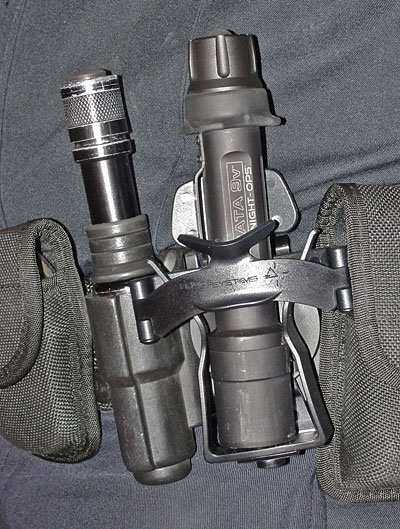
Gary Grundy of Helios Systems was gracious enough to allow me to test and evaluate one of the Cyclops. For testing I used my Safariland duty rig and my tactical vest equipped with the Molle system. I selected five commonly used police flashlights: the Blackhawk 9-volt Falcata; the Streamlight Poly Stinger; the Surefire Z2; the Surefire 6Z; and the Blackhawk Gladius. All of these flashlights have a thumb activated on/off button for tactical use.
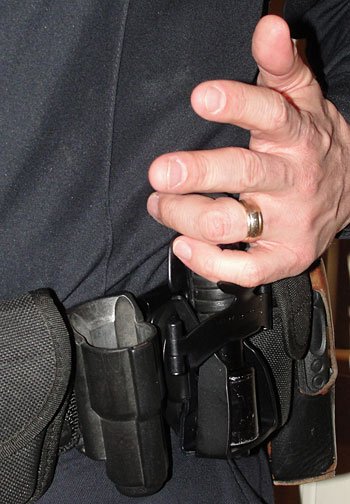
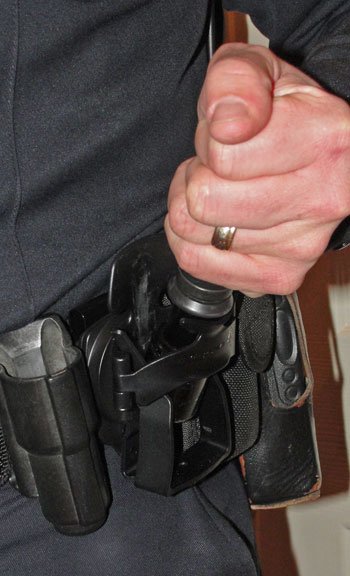
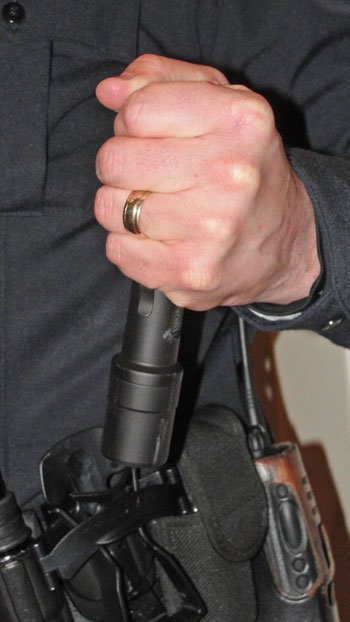
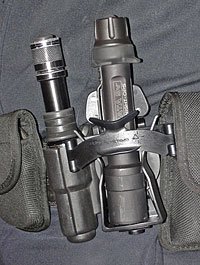 During the testing, I found the smaller Z2, 6Z and the Gladius are held more snugly by the Cyclops than the larger lights. However, the location of the front strap leaves only about 1.5 inches of the Z2 and 6Z, and about two inches of the Gladius, exposed at the top of the Cyclops to grab for withdrawal. With the “halo” headrest this made a secure grip even more difficult than open top style carriers. Withdrawing these two flashlights was not impossible but was awkward, as I was only able to get two fingers on the Z2 and not quite three fingers on the Gladius. I consider myself as having average-sized hands (usually a medium or large glove size) so someone with larger hands might have even more trouble with retrieving these two particular flashlights from the Cyclops.
The Falcata and Poly Stinger have taller bodies, and I found that I could easily grab the top of those flashlights with all four fingers, making withdrawal easy and comfortable. However, I found that the taller bodied flashlights were more susceptible to jostling in the carrier from normal field use. I’m not sure if this was caused by the Cyclops carrier sitting further from the body than some carriers or if the vertical “X” straps (free floating to adjust to different sized flashlights) were not stiff enough to maintain a nice vertical position on the flashlight. This caused a minor inconvenience during withdrawal as muscle memory would place my retrieval hand at the position where the flashlight was held in a vertical manner and I would then have to adjust slightly for withdrawal. This jostling did not affect the ability of the Cyclops to retain the flashlights, only the position that the flashlights were held during field use.
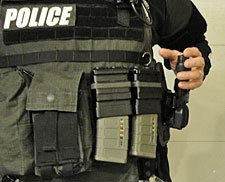 I like the Cyclops’ design and function, but I did discover a potential spacing problem due to the wider measurements and deeper dimensions that place the Cyclops further away from the body. For most civilian users this should not be a problem but for law enforcement and military users, who are already heavily laden with equipment, and short on space, a larger carrier could present space problems.
On my duty belt I carry my Glock 22 in a Blackhawk Serpa duty holster, I have a double magazine pouch laid horizontal, an ASP baton in a case, O.C. spray in a case, two single handcuff cases, a swivel radio holder, a Surefire 6Z flashlight in its standard holder, and a cell phone case. Add in four belt keepers, and a key chain holder used for a spacer, and my belt is desperately short of space. I would not consider placing such a valuable tool (a flashlight) in the small of my back, as that position makes deployment difficult at best and impossible at worst.
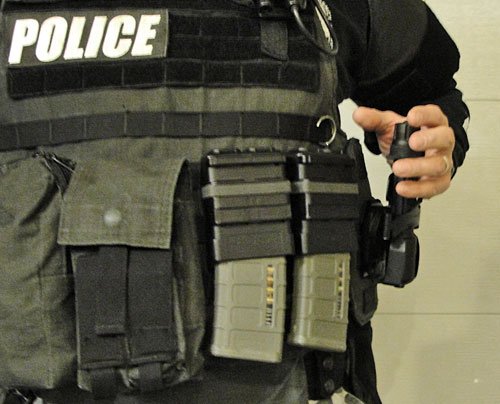
I was able to find room for the Cyclops but had to take my cell phone case off to accomplish this. Many officers carry two flashlights in holders on their belts already, often times side by side for easy muscle memory during draws, so I placed my Cyclops next to my 6Z holder. Even with the phone case missing I found that I had to make minor adjustments to my other gear to fit it on my belt. Once placed though, I found the Cyclops to be a nice addition to my duty gear and it quickly gained the attention of fellow officers curious about its design and function.
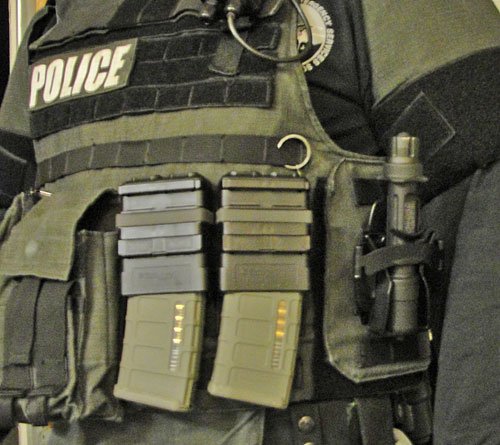
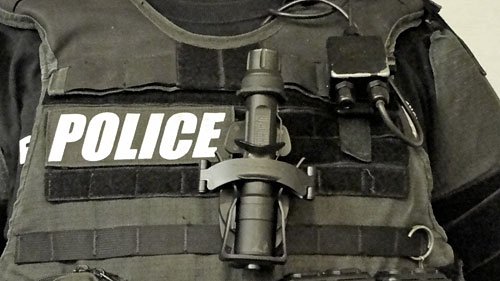
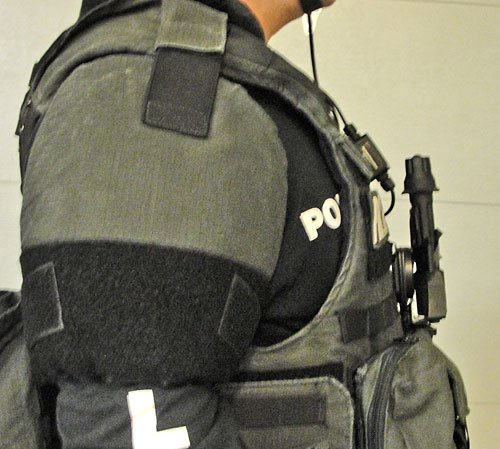
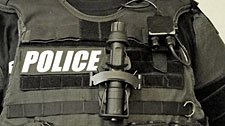 When I examined my tactical ballistic vest I found that the only real option for a mounting position for my needs was on the front panel. I mounted the Cyclops at chest level, and I was able to access the larger flashlights fairly easily without the mounting position interfering with proper rifle shooting platforms. This position did make it somewhat difficult to let the rifle hang by its tactical sling as the sling or rifle would bump into the Cyclops during normal movement. I’m confident that the Cyclops could be mounted along the bottom of the panel and towards the sides, which would allow for easy access and less jostling by a slung rifle, but for my equipment placement preferences that option was not available.
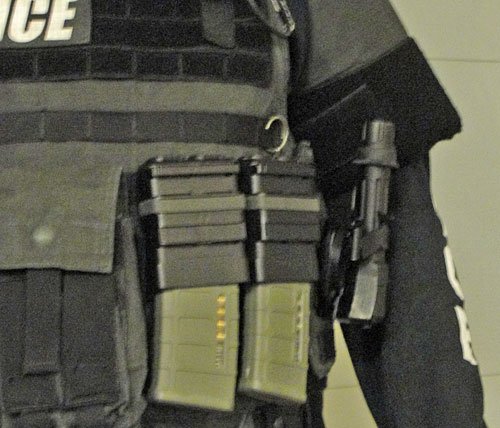
I did attempt to mount the Cyclops on the left side panel of my tactical ballistic rig (I’m right-hand dominant so I wanted an off-hand draw) but I quickly realized that the depth of the Cyclops made it stick out too far to be practical. I was bumping into it all the time in that position. A right side panel placement would have the same issues with arm movements or transitions to my sidearm. I did not attempt a rear panel mounting, but I believe an up-side-down (6:00) placement at the kidney area might work. However with a bulky tactical rig moving arms to the back is not very natural or comfortable and remounting a flashlight would prove difficult.
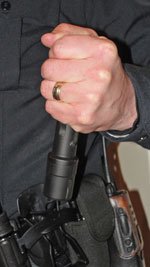 On another note, I noticed that flashlights with a special coating on their outer body (like the Falcata or Gladius) started to show wear marks from repeated draws from the Cyclops. Sometimes these marks could be wiped off, but after awhile some of the marks remained. These use marks did not appear to compromise the flashlight body’s longevity by reaching the metal underneath the coating, but merely affected the aesthetic appearance of the flashlight. The painted flashlights did not show wear marks as easily. The Cyclops itself showed some minor use marks near the bell “neck” and the vertical back brace, but nothing that would not be expected for repeated use. The marks on the Cyclops did not appear to affect its longevity at all.
Having considered all the benefits and limitations I would say that the Helios Systems Cyclops flashlight holder would make a nice addition to any officer’s duty or tactical rig. With the ability to house many different styles and shapes of flashlights officers, civilians and military users alike have a very versatile tool to make quick transitions between lights from the same location on their gear. This is great when the needs of a flashlight changes (e.g. field searches to up close work) or if a flashlight goes down. The operator can quickly place a different flashlight in the same holder and the operator doesn’t have to remember a different flashlight holder location in the heat of action.
The ability to rapidly change deployment positions for personal preference, and to quickly change from duty rig to Molle gear is a great plus also. With the wider and deeper size measurements of the Cyclops this product may ultimately come down to personal preference or space availability, especially on the ever decreasing space on duty and tactical rigs that are already bulky and full of gear.
Aaron is a sergeant with a midwestern police department, where he serves as a trainer, supervisor and SWAT sniper. In addition to his broad tactical knowledge, Aaron has experience in DUI, DRE and undercover narcotics investigations.
Leave a Reply