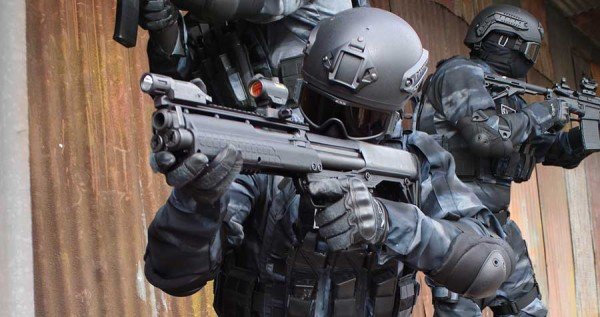
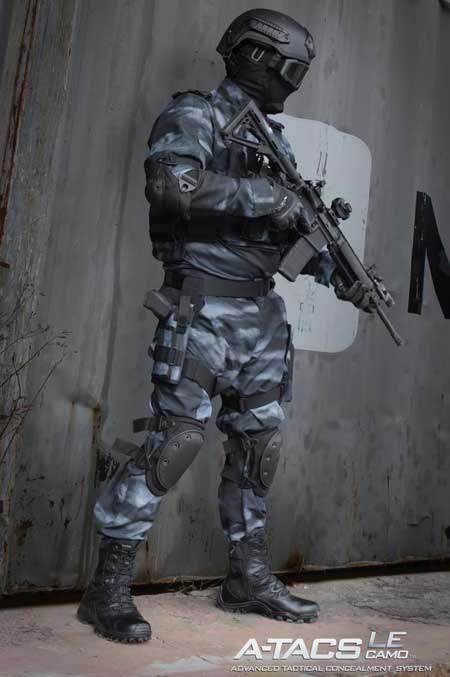
A-TACS showed off their new LE Camo pattern at the 2013 SHOT Show last week. The new pattern uses grays, blues and black to create a unique pattern that is supposed to work well with existing black duty gear the officers may already be using.
According to A-TACS the pattern incorporates shadows and “variable angles and urban forms derived from photography.” The company states the pattern has a slight horizontal flow to it. I would agree, and I also think the pattern has a subtle tiger stripe-like flow. The subtle color variations in the pattern are impressive.
The new pattern is interesting, but I don’t know how useful it may be for a SWAT team in an urban environment. I do not claim to be an expert in camouflage, but I just don’t know how useful any pattern may be in a truly urban environment.
I would think that a team may be better off choosing a MultiCam or A-TACS FG pattern that works with the typical vegetation for the region. That pattern would not help against the side of a building, but when deployed to a backyard tree line, it would help. I don’t know that the A-TACS LE pattern would help in either scenario.
Does anyone out there with more experience care to chime in on how useful this pattern may be?


When I heard they were coming out with a LEO pattern I was hoping it wouldn’t have blue in it like those old “urban” patterns. I’m not sure why people think blue should be in any pattern (Navy).
I agree that Multicam or the other two ATACS patterns would be much better. Trying to match a uniform to current issued black duty gear isn’t a great idea in my opinion.
I guess if you were in downtown NYC this might work, but from the photos I’ve seen so far I’m not a fan of the pattern.
Eric –
Your navy comment got me laughing. When the USN went to the digi blue camo pattern (whatever the official name might be), my brother lost his sh!t. As he explained it, one of the leading causes of death for sailors is falling overboard and drowning. By making them wear blue camo, he assumed the navy really was trying to kill him.
-Richard
Traditionally SWAT had dark blue or black uniforms. Add to that black tac vests, and gear. I think ATACS is still catering to that image. A lot of warrants have been served late at night or early in the morning when it was still dark. In that time frame this camouflage may be fine, but in any kind of lighting it is kind of pointless. There are several court cases around the country that are pushing LE to move away from these tactics except for warrants that are clearly a threat to officers – not just simply a drug warrant.
I think a multi-cam or ATACS foliage is the better all-around camouflage pattern. Many agencies are switching to these patterns or similar colors – even for their heavy vests and helmets. A lot of sheriffs’ teams and some State agencies have done so, where many city agencies stick with black or dark colors. Our team is split. Entry still uses urban camouflage, where our snipers are in multi-cam. However, some agencies/chiefs are concerned with looking too militaristic, so avoid the more green patterns.
I was talking to the guys at Ares Armor during SHOT, and they pointed out the current LE pattern, is supposedly changing to incorporate more greys and less blues.
The way the pattern is now, is pretty useless for any type of day ops, unless you’re strictly Maritime.
Patterns with primarily Greys and Greens are pretty much the best for Urban settings. It’s one of the reasons why the Arc’teryx LEAF Urban Wolf is so effective.
One of the long-time justifications for the black ‘tacti-cool’ clothing and equipment is the intimidation factor. A team of heavily armed MIB forcing entry into a criminal’s place of safety is is a shocking display of force. I don’t like my team’s all black entry gear; however, it is effective.
I like the look of the A-TACS LE, I just wish we had the expendible $ to try out and compare new uniform designs. We have more important things to spend our limited $ on tho…
That being said, there must be a market for it, or companies would not spend the $ to develop a LE-only pattern.