Strangulation is a very grave form of battery in domestic violence (DV). By some estimates, about 10% of all women who experience domestic violence will experience a near fatal strangulation by their partner, and they are 7x more likely to be killed by their partner than any other victim of DV.
Strangulation is so serious that according to the National District Attorneys Association, 10% of all violent deaths (not just DV) in the United States are attributable, at least in part, to strangulation. That is a huge number, and one that demands police officers properly investigate and document strangulation cases.
What Is Strangulation?
Strangulation is simply cutting off the blood flow and/or the air flow by applying external pressure to the neck. Cut off fresh air (via the blood) to the brain, and brain death will occur.
Strangulation can be accomplished one of three ways: hanging, ligature, and manual. Hanging is typically found in suicides and auto-erotic asphyxia cases. Ligature is the use of a piece of rope, chain, or other material the strangle another person. Manual is the use of personal weapons, such as our hands and arms, to strangle another person.
Signs of Strangulation
Recognizing the signs of strangulation is the first step in prosecuting this type of battery.
Typically, the first indicator a police officer may have in a strangulation case is the victim’s statements. The victim may say “He choked me!” This is a good first indicator of a serious attack.
External signs of a strangulation victim may be very minor, if they are visible at all. San Diego conducted a survey of 300 misdemeanor strangulation cases. In 50% of the cases, there was no visible injuries. Another 35% had visible injuries so minor, that they would not show up in photographs. That means that the victims in only 15% of all strangulation cases studied had injuries significant enough to (1) be seen, and (2) be photographed.
When present, visible injuries may include:
- redness to the neck
- scratch marks on the neck (from the victim trying to remove her attacker’s hands)
- thumb print bruising
- petechiae (red spots) in the eyes, or in the skin of the neck, head, and face
- neck swelling
Additionally, a police officer may hear the victim’s voice as raspy, or the victim may even lose her voice entirely. About 50% of all strangulation victims experience a voice change from the physical trauma.
Other signs that strangulation has occurred:
- the victim “blacked out” or lost consciousness
- the victim lost control of their bowels or bladder
- breathing difficulty
- unusual behavior changes
- ringing in the ears or even loss of hearing
- headache
Strangulation, Not Choking
A quick note about terminology. “Choking” is what happens when something lodges in the throat, blocking the airway. For example, a piece of food.
“Strangulation” is what happens when someone grabs another person’s neck/throat, and begins to cut of air and blood flow. Many victims will say “choke,” but you better say “strangle” when testifying.
Medical Emergency
Stopping the blood or air flow to the brain can be accomplished by occluding the carotid artery, the jugular vein, or the trachea. It takes about 11 pounds of pressure to occlude the carotid artery, and only about 4 pounds to occlude the jugular vein. You can easily generate that much pressure with a single finger.
Blocking the blood flow through the carotid artery or the jugular vein will render the victim unconscious in about 10 seconds. Even though the brain can survive up to four minutes without fresh oxygen, the research done by Dr. Luis Pena has shown that in some cases if the victim is strangled for 50 seconds past consciousness, they are past the point of no return, and death is a near certainty.
The trachea, on the other hand, is the point where air, not blood, flows. The trachea requires 33 pounds of pressure to fracture. However, a fractured trachea is a dire injury, and although treatable, death is a very possible outcome.
So, let’s say there are allegations of strangulation at an incident you are investigating, but the victim appears to be fine. The danger of death has passed, right? Unfortunately, no.
Death from strangulation has been known to happen up to 36 hours after the attack. How?
The neck is largely made up of muscles. The muscles, when wrenched during the strangulation attack, tend to tear and bruise, leading to swelling. This internal swelling applies pressure to the veins and artery, cutting off blood flow.
Remember, it only takes about four pounds of pressure to occlude the jugular vein. Once blood flow is cut off, you only have 10 seconds before unconsciousness hits, and only 50 seconds beyond that before death becomes a very real possibility.
If a victim says she has been strangled, strongly encourage them to seek medical assistance. While most refuse a ride in the ambulance, taking the time to explain the seriousness of the potential injuries may save their life.
I strongly recommend that you have EMS respond to the scene for any victim of strangulation even if the victim indicates she doesn’t want treatment. Sometimes a paramedic can gain cooperation for an exam when the police officer cannot.
Even if the victim refuses treatment, you can show you provided every opportunity for her to receive treatment. Make sure you document that you attempted to provide a medical evaluation. Should the victim’s condition worsen later, you have documented you did everything possible to assist when you were on scene.
Documentation
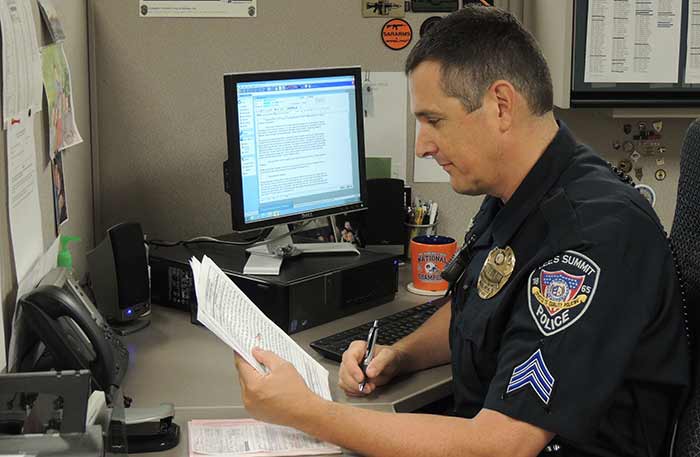
In the majority of domestic violence cases, there are few, if any, independent witnesses, and often the victim will later recant her story. So, right off the bat, a police officer has the deck stacked against him in a successful prosecution of this high lethality battery.
However, with the proper documentation by the investigating police officers, strangulation cases can be successfully prosecuted.
Document the physical evidence on scene. Make sure that you write a complete, detailed description of the scene in your narrative. Victims who are being strangled are fighting for their lives. Fights tend to make messes. Document broken glasses, chairs, disheveled bedding, holes in the drywall, lamps that are tipped over, etc.
Document the victim’s injuries. Write down all of your observations of the victim. You should obviously include things such as red marks and scratches on the neck. You should also include victim behaviors that are consistent with strangulation such as difficulty swallowing and a raspy voice.
Photograph everything. Quality photos trump most of the arguments the defense can produce. If you have an evidence tech available to you, use him or her. If you are taking the photos, make sure you photograph the victim’s injuries and scene. This is one of the best ways to show the jury what had happened.
Obtain audio recordings. Depending on your state’s laws and rules of evidence, taped interviews of the victim and suspect can be admitted into court under certain circumstances. Understand what those rules of evidence are and use a portable tape recorder to capture interviews on scene.
If a victim recants, an audio recording may be admissible to help win the case. Likewise, a recorded post-Miranda confession will likely ensure a conviction.
Another audio recording to submit into evidence is the original (and any subsequent) 911 call. Hearing the victim screaming for help on the 911 line is likely to convince the jury of the seriousness of the attack.
One other audio recording to think about is your radio traffic. I imagine almost every department records the radio traffic in case of pursuits, officer involved shootings, etc. If you are talking on the radio while the suspect is yelling in the background, that may be a good bit of evidence that the jury needs to hear.
Medical Records. Your department should have a medical record release form that you can have victims sign to obtain their records from the paramedics and emergency room. If your victim is treated by paramedics on scene and/or hospital staff in the ER, the medical professionals will do an excellent job at documenting the injuries she has suffered.
These records (1) help prove the strangulation actually occurred, and (2) will help show how serious this type of battery really is. Get your victim to sign the release, and get copies of those records into evidence.
Online Training
The Training Institute on Strangulation Prevention offers a free online training course for police officers. This training class on domestic violence strangulation is about 25 minutes long and gives you additional tools for investigating these kinds of crimes.
The free training class is here.
In addition to the online class, the institute also provides in person training to agencies around the country. In an ideal situation, you can set up the training in partnership with your prosecutor’s office to get both the officers and the attorneys on the same page for court.
Domestic violence strangulation is a very serious crime. Some jurisdictions can use strangulation as evidence of an attempted murder. The point is the victim is in a dangerous situation, and it is extremely important that you conduct an excellent investigation, document all of the evidence and provide all of the medical care the victim may need.
Stay safe!