In today’s society the professional law enforcement officer must realize that performance in deadly force encounters will ultimately come down to muscle memory obtained from hours and hours of training. This doesn’t take away from our physical fitness requirements. In particular though, our weapons handling skills will most likely be the final determinant of our successful or failed attempts to stop an armed subject.
From drawing your firearm so many times that you literally don’t think about it, to shooting enough rounds to know your weapon intimately. From so many magazine reloads that a day without them is boring, to sight alignment drills that teach the shooter to be on target every time they raise their pistol. So far I know I’m preaching to the choir, so the point of this article goes to the next step on training and preparation for deadly force encounters.
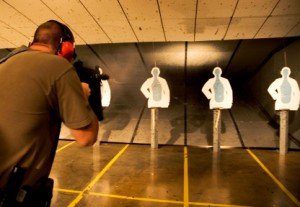
When I started in law enforcement 13 years ago my agency’s standard pistol qualification course involved shooting at static, paper targets from a variety of distances. And let’s face it; most agencies were about the same. About the only significant movement we had was to put up our off hand to simulate blocking strikes at the 1 and 3 yard range, and maybe do a step and drag to create distance. At greater distances the only “stress” was getting your shots off in the prescribed amount of time.
Don’t get me started on shotgun training. Back then we shot at varying distances with 00 Buck and a five Slug shots from 50 yards.
These were our “qualification” courses! We did a few malfunction drills during the “training” courses, but then we laid down a ground ball to second when it came time to “qualify” because heaven forbid an officer failed qualification. That would mean the officer’s firearm had to be taken away and they would be put on administrative leave until corrected. Of course that meant more overtime and an inconvenience to all involved.
I think you all can see where I’m going with this. These types of firearms training programs have a place in modern law enforcement. Learning and emphasizing the basics is an absolute must, but there must also be a push to advance our skills if we expect to survive in the heat of battle.

Most of us have heard of the California Highway Patrol massacre in the 1970’s where four highway patrolmen were murdered when they attempted to apprehend two heavily armed parolees with a plan. In the aftermath of that incident it was found that several of the highway patrolmen had empty brass casings in their pockets – a learned habit from range-day training where the range master was overly concerned with loose brass on the range. What a terrible price those officers had to suffer to recognize that our training habits (good and bad) often dictate the outcome of deadly force encounters. This article is meant for us to take a real hard look at our firearms training courses. Are we training just to drill, or are we training for the real thing?
Don’t think this is just one gun-loving cop’s idea either. The courts around the country recognize that officers must be properly trained for situations that they are likely to encounter.
In Canton v. Ohio the U.S. Supreme Court ruled against the city involved because of a failure to train adequately. In that case the petitioner was a citizen that had been harmed (medically) due to inadequate police training. Under this precedent an agency could be sued by their officers who are injured or by their families should they be killed in a shooting engagement and the agency’s firearms training did not meet realistic skills requirements. Or what about an innocent bystander that is shot because officers were forced to shoot at moving targets or maybe shoot while they were moving themselves.
Firearms training that did nothing but put holes in stationary paper targets could quickly be attacked for inadequate training. Poor firearms and defensive tactics training is a liability time bomb waiting to go off. If your agency has the “that’ll never happen here” mentality, you might respond back that by their authorization and issuance of firearms they have clearly recognized that they believe firearms are necessary to complete the police mission, and thereby proper training is required.
In a real-life shooting situation officers are going to respond the way they were trained. Either they will resort to sound techniques and win, or they will resort to a wild “fight or flight” reaction that at best gives the officer a 50/50 chance. We know this so it is our duty to prepare them to win. Teaching officers to simply stand in front of a stationary paper target is not accomplishing this goal.
So here are some suggestions on what a real-life course of fire should incorporate:
- Shooting from various positions (standing, squatting, kneeling, sitting, prone, modified prone, etc.).
- Shooting with our off-hand (a critical officer survival technique).
- Proper use of barricades! .
- Shooting on the move! This should be done both strong hand and off-hand.
- Using some form of exercise to simulate stress – sprinting, push-ups, etc.
- Shooting at moving targets. Shooting at extreme close quarters.
- Body armor drills. Officers need to quickly assess if their rounds to center mass are not stopping the threat and quickly move to head shots or shots to the pelvic girdle. Teaching to shoot at various locations on the body will maximize an officer’s chance of survival and ensure maximum damage to our adversary. Teaching to shoot in a small, defined area may be a death trap to a subject wearing heavy ballistic armor.
- Keeping your gun in the fight with tactical reloads.
- Shooting at steel – there’s nothing like the real-time feedback and it’s more challenging than a big paper target.
- Low-light shooting and proper flashlight use. Teach officers to move under the cover of darkness or intermittent light use. Once they locate a threat they need to illuminate the target for effect – massive light to blind the bad guy and create a nice target picture.
- Team shooting! This is not a tactical team only skill! Many of us respond to potential threat calls with additional officers. We need to train officers to take up complimentary shooting positions (the high-low stack for example) and to be comfortable being in close proximity to another officer shooting. We also need to teach officers how to safely move around other officers with our weapons out.
- Communication! Officers need to be trained to communicate with backing officers or with dispatch to keep the good guys informed and the bad guys confused about our movements or intentions.
- Incorporating the back up gun into regular training.
We all have to take a critical and honest look at our firearms training and develop programs that will prepare our officers with skills to survive and win. We must step out of our comfort zone and start training for the real and not just to drill.
In Part II of this article I will go into greater detail about the concepts presented here, and provide an example of a course of fire that every agency could be able to implement to give their officers the skills of survival for the real deal.